Hello from Golden Touch Craps/Blackjack:
Welcome once again to the new Golden Touch e-Newsletter, keeping you in touch with all our latest offerings and new articles.
|

New Articles Since Last Issue...
We have lots of great new article in this issue. We've included many of them directly in this e-mail, or you can link to them and read them online.
Articles: Henry Tamburin on Blackjack...
Henry Tamburin, Lead Golden Touch Blackjack Instructor and well-known blackjack author, provides a number of great articles to improve your game. Read his latest article below, Blackjack Card Counting 101 - Part 1. Henry also has one other new article since our last e-newsletter: Pictures Always Follow Pictures.
Blackjack Card Counting 101 - Part 1
By Henry Tamburin
Do you remember the blackjack scene from the movie Rain Man? You know that's where autistic Dustin Hoffman is card counting at the blackjack tables at Caesars Palace in Las Vegas and telling his selfish brother (Tom Cruise) how to play and how much to bet. Cruise is winning and winning big. The scene shifts to the casino surveillance room (infamous eye-in-the-sky) where two employees are trying to figure out how Cruise is winning all that money playing blackjack. Finally, one says: "He is not catching a hole card, he isn't past-posting, and I don't see him using a computer. But something is not right - you know there is no one in the world that can count into a 6-deck shoe".
Do you really have to have a photographic memory like Dustin Hoffman to be a card counter? And is it really true that "no one can count into a six deck shoe?" The quick and dirty answer to both questions is, No and No. In fact, card counting is a strategy that anyone with average intelligence can learn. In fact, you can do it!
Unfortunately there are myths associated with card counting. We've already mentioned two of them and here are a few more: card counters win every time they play; card counters can make millions; casinos ban all card counters from playing blackjack; and card counting is illegal.
I'm a blackjack card counter; been one for 38 years. Even though most people are amazed that I can memorize the cards from a 6-deck shoe that's not what I do. Nor do I win every time I play or I wouldn't be writing this article. And no, I'm not writing this article from a jail cell but I'll admit that a few times in my career I was barred from playing blackjack (that was a long, long time ago). Nowadays, I play uninhibited.
So what is this thing called card counting and can you really do it? Follow along and I'll show you what it is and then you can decide if it's for you.
First, card counters do not memorize every card that is played. They keep track of the cards by assigning a value or tag to each card. For example, the popular High/Low card counting system assigns a tag of +1 (that's "plus" one) to every 2, 3, 4, 5, and 6 value card and -1 ("minus" one) to every 10, jack, queen, king and ace. The 7, 8, and 9 value cards have a tag of 0 (these cards are ignored). Card counters then arithmetically add the tags of each card that they see on the layout. For example, if player #1 has a two card hand consisting of a 6 and a 4 and then drew a 10 for a 20, a card counter would add the tags for each of the cards to arrive at the sum of +1 (this is known as the "count").
Card Tag Sum
6 +1 +1
4 +1 +2
10 -1 +1
Note that because the tag for a 10-value card is -1, you must subtract 1 from your count.
Are you surprised that card counting is nothing more than adding "plus ones" and "minus ones" like you did back in grammar school? Obviously at the end of a round and after you have counted all the player cards and the dealer cards, you will have a sum that is either a plus number or a negative number. This sum is known as the running count.
Suppose the running count is a positive number after the first round of play. What does this tell the card counter? In order for the running count to be a positive number, there must have been more small value cards played in the previous round vs. high value cards (remember the small cards have a tag of +1 and the big cards have a -1 tag). If that's the case then the opposite must be true for the undealt cards in the shoe, namely they must contain more big cards over small cards.
Let's recap. If your running count is positive, then the undealt cards are rich in big cards. On the other hand, if the running count is negative, the undealt cards are rich in small
cards.
So card counters indirectly have some knowledge of the ratio of big cards to small cards on the next deal by keeping track of all the cards that were played in the previous rounds. Card counters then use their count to vary their bets on the next hand.
They INCEASE their bet size when the count is POSITIVE and
DECREASE their bet size when the count is NEGATIVE.
Why do counters increase their bet size when the undealt cards are rich in big cards? The high value cards are more favorable for the player because there will be more blackjack hands dealt and the players receive a bonus payoff when they get a blackjack (not the case when the dealer gets a blackjack). Here are some more reasons why a deck rich in high cards is player favorable.
- High cards will bust a dealer's hand when they are forced to draw on 12 through 16.
- A player will usually make good on double downs when the shoe is rich in big cards.
- Many pair splitting opportunities are more favorable with an abundance of big cards left in the deck and
- Insurance can become a more profitable bet when there is an excess of big cards.
The point is BIG CARDS are favorable for the player.
What about those small cards. Since dealers are forced to hit when they their hands total 12 through 16, small cards prevent them from busting these hands. Therefore, small cards help the dealer more than the player.
Card counters gain the upper hand over the casinos because they have more money bet when they have they edge (positive counts), and less money bet when the casino has the edge (negative counts). Counters actually lose more hands than they win but they win more money because they have a lot more bet on the hands that they win compared to the amount of money bet on the hands that they lose. It's that simple.
You are probably wondering that when the count is positive "won't the dealer have just as much chance to get the big cards as I will?" The answer is yes, but players can double down, pair split, get paid 3 to 2 on blackjacks, and unlike the dealer, don't have to hit a hard 12 through 16 when the shoe is rich in big cards. This is what creates our basic edge over the casino when the count is positive.
Now that you get the picture on the mechanics of how to count cards, you've probably wondering if it's still worth your time to become a card counter. There is certainly a lot more that you've got to learn but here are some points that you need to consider before you decide to forge ahead.
Profit Potential
Suppose you play 5000 hands of blackjack per year (about 60 hour's worth of blackjack) and you average bet size is $10. If you use an "intuitive" playing strategy, your expectation is to lose about $1,000. If you are a good basic strategy player, you will cut your expected losses to $250. A card counter, on the other hand, has an expected win of $500, which is $1500 more than the intuitive player and $750 more than the basic strategy player.
Don't play that much blackjack in a year? Here are the same expected results for 200 and 1000 hands. You still have the potential of being ahead with card counting but of course not as much as a player who plays more or bets more.
Player 200 hands 1000 hands
Intuitive -$40 -$200
Basic Strategy -$10 -$50
Counter +$20 +$100
The above expected results are averages. Most likely a player will win or lose more than this, however, as a general rule the more hands of blackjack you play the closer you will come to your expected results.
In my next article I'll continue the discussion on how to be a successful card counter.
To receive a free 3-month membership to Tamburin's Blackjack Insider e-Newsletter, visit www.bjinsider.com/free. For a free copy of his Casino Gambling Catalog containing 50 best-selling products call 888/353-3234 or visit the Internet store at www.smartgaming.com. For details on his Golden Touch Blackjack course featuring "Speed Count" call 866/WINBJ-21 or visit www.goldentouchblackjack.com.
Do you have to be a Math Whiz to win at blackjack?
NO! Speed Count, the easiest advantage-play blackjack method will have you beating the casinos in only a few minutes of practice. It really is that easy... if you ever play blackjack in the casinos, then you are crazy to not learn the Speed Count card counting method. Add blackjack to your game-plan to beat the casinos, and Speed Count is mathematically proven to get you an edge over the casino.
Endorsed, tested, and used by Golden Touch Craps...
The following software bundles are currently discounted. Nothing is shipped to you: you get to download the full software version immediately after you purchase and use it right away. Here is the list of features in each bundle:
Program/Feature |
||
| Blackjack Counter software |
|
|
| Blackjack Expert software |
|
|
| Speed Count System |
|
|
| Golden Touch Blackjack Revolution! e-book |
|
|
| Blackjack Count Master e-Book |
|
|
| High-Low Count System |
|
|
| Blackjack Audit |
|
|
|
Purchase a bundle: (choose a platform) |
Price: $55 (normally $65) |
Price: $85 (normally $95) |
|
Installation program, trial version: |
||

Last year, the movie 21, featuring Kevin Spacey and Lawrence Fishburne, opened in theaters around the country. Join the ranks of savvy blackjack players who get the edge over the casino, without the need to be a mathematical genious and months of training! These software bundles contain absolutely everything you need to become an expert card counter, with a focused training regime including pass/fail exercises so you know when you are ready to hit the casinos.
Other software discounts from DeepNet Technologies:
Smart Craps Professional for Windows (www.SmartCraps.com)
- Normally $129.95, yours for only $95. Click here to order online (immediate online download, not shipped)
- Find out if you can control the dice at craps . Prove whether your dice control skill is working, and what edge you can get.
- Includes the Smart Craps simulator, Roll Recorder for Windows and Palm OS, dice set optimizer, advanced betting module, and much more.
Poker Drill Master for Windows (www.PokerDrillMaster.com)
- Normally $59.95, yours for only $49.95. Click here to order online (immediate online download, not shipped)
- Learn to correctly determine poker pot odds, and make the best decisions at every betting opportunity.
- Use the incredibly fast and powerful poker calculator that tells you the winning probabilities and odds for any combination of known and unknown hands and/or board (just like on TV).
- Use the powerful poker system editor that lets you select from supplied pre-flop decision methodologies by popular authors and experts, as well as edit or create your own systems.
- View the Outs table to quickly find single card outs probabilities and pot odds with one or two cards to go.
Speed Count Database Add-on For Existing Users
- Normally $30.00, yours for only $25.00. Click here to order online (immediate online download, not shipped)
- Already own our great blackjack training program Blackjack Counter? The purchase the Speed Count database add-on only. Good for all platforms (Windows, Palm OS, Pocket PC).
More discounts for Palm OS and Pocket PC versions as well: http://www.deepnettech.com/specials1.html.
Scoblete keeps pumping out the wisdom...
New gambling articles by the prolific Frank Scoblete himself. His latest article below is The Slot Spin Principle.
The Slot Spin Principle by Frank Scoblete
Steady readers of slot articles know one thing; their chances of coming out ahead in the long run are remote, really, really remote. A big progressive win of millions would do it, of course, but bucking an estimated 50 million to one odds on those giant progressive machines just isn't in the cards, or reel spins, for just about every slot player. Slot players know this, if not intellectually, at least instinctively.
Hope all you like but I am betting that you don't make it. Nor will I.
So what do many slot players do? They come up with highly logical and totally incorrect ways to play the machines thinking their logic can overcome the randomness programmed into the machines. Since the machines can't be beaten in the long run, all logical systems of play must by definition be wrong. So much for logic. Something might sound good but if it doesn't work, it isn't worth thinking about.
Yes, I will admit that good money management, smart selection of lower house-edge slot machines, reduction in the number of spins per minute and all of those strategies are truly helpful to keep your head and pocketbook in the game, and also your spouse from being annoyed with your play. But a logical approach to win at the one-armed bandits? Nope. Only if you can play the machines described in Jerry "Stickman's" book Specific Slot Machines That Give the Players the Edge! can you expect to win in the long run.
So I have decided to offer to the Jackpot readership my new, unique strategy that has never been thought of before and, obviously, never tried before. It's called "Slot Spin." Since logic cannot beat the randomness of the slot machines, what about randomness itself? Can a truly random approach to the game generate wins? Probably not but who cares? Since nothing works in the long run except "Stickman's" machines, my strategy won't work any worse. So it is definitely worth a try. The only thing you have to lose is your money.
Now what do I mean by randomness beating the randomness of the slot machines? Here it is - prepare yourself for true genius now - you do something random that then tells you how to play the machines you wish to play!
This strategy will work on two, three, four, five and six line machines. It won't work on those new billion-line Australian machines created by marsupials.
Specifically take a single die and spin it randomly. Just spin it and then drop it. If it lands on the two spot, you will play two coins in the machine. If it lands on the three-spot, you play three coins. Whatever the die lands on that's what you play. But for each upcoming spin you must spin your die first.
Now if the machine you are playing only goes up to three coins, then you ignore the die should it fall on the four, five or six spots.
Please keep in mind you must spin the die. The spinning is a key ingredient as it is in politics and in teenage logic.
Here is the logic of my non-logical system. There is a concept in physics called the spin relationship or principle (or something like that) where atoms that were in relation to each other are still in relation to each other no matter how far apart in the universe they have become. So, to make this simple so I can understand it, if one atom is spinning one way, the other atom will spin that way too. They are in some unfathomable way connected to each other.
Once you understand the spin principle then you apply that to the randomness of the slot machine. I am stating equivocally that the spin of randomness can be transferable from one random event to the other if, and this is the important if, your mind thinks about it strongly enough.
Now you have two ways to approach the "Slot Spin" principle. You can bring a die to the casino to spin in front of the machine. However, that could cause other slot players to stand around you guffawing at what an ploppy they think you are. You can ignore all of them because their strategies are losers too.
But if your public persona is such that you prefer to remain respected or ignored by other slot players, then you can do several thousand spins at home, come to the casino with sheets of paper and use these to determine how many coins you will play.
Obviously, even with my "Slot Spin" strategy you will not win every single spin of the reels. I can't promise you that kind of performance. Actually I can't promise you any kind of performance but my principle will certainly add another element of thrill to playing the slot machines and who knows, maybe I have uncovered the true secret to beating those machines.
If you can win at slots, well, there's a spin I really like!
NEW! Dominator's Golden Touch™ Sports | ||||||||||||||||||||||
|
| ||||||||||||||||||||||
|
Dominator has been beating the Vegas sports books for over 20 years now, and for the first time ever he is sharing his predictions with our Golden Touch customers through our new Golden Touch™ Sports Pick Subscription Service. Five day trial subscription... only $9.95! Articles: Stickman's stance... craps from the front line!'Stickman' is a lead GTC and GTB instructor, and a proven veteran of dice control. Jerry has two new articles in this newsletter: Playing a "Hopping 7's" Progression with a controlled shooterby Jerry "Stickman" Hi Stickman, I have read your articles and enjoy them. I have a few questions about betting that I hoped you would answer. Which are better bets or does it depend on the SRR? Assume $10 table min. 5Xs odds. Example 1. $10 pass line with $20 odds when the 5 and 9 are points place 6 & 8 for $30 each and buy the 4 & 10 for $20 each. (Are there different amounts to bet considering the point number specifically the odds amount?) Example 2. $10 pl with $50 odds (max) place 6 & 8 for $30 each and only buy the 4 or the 10 initially for $20. Are max odds always a better bet and placing the 6 & 8 before buying the 4 and/or 10? Finally, if the 4 or 10 is bought for $20 once it hits do you collect $35 and press the bet to $25 or what pressing/collecting method is suggested. Thanks,
Bruce, These are very good questions. Deciding which bets to make tends to be a fairly personal choice. Do you want to get the absolute best return from every dollar you bet at the table - even if it is at the expense of losing some control over your bets? Or would you rather have a reasonable chance of getting several hits on your bets but still keep the house edge low (or even have an edge if you are able to control your dice throw)? With pass/come bets, the base portion of the bet is where the house gets their edge as the payback is even money. Any odds placed have no house edge (or player edge for that matter). So if you bet $10 on the line, the house edge is 14 cents. No matter how much you add in odds, the house will take 15 cents on average. Adding odds will reduce the house edge percentage but increase volatility as you will win or lose more on each decision. When betting a $10 pass or come bet, any multiple of $10 as odds will work regardless of the point. If the point is 6 or 8, each $10 returns $12 on a win. If the point is 5 or 9, each $10 returns $15 on a win. Each $10 in odds for a point of 4 or 10 returns $20. From a purely mathematical standpoint pass/come bets with max odds is the best choice. A pass or come bet with 5 times odds has a house edge of a mere one-third of one-percent (.33%). Buying the 4 and/or 10 for $25 or$ 30 with a $1 vig on wins only actually has a better house edge (for the player) than placing the 6 and/or 8 (1.33%/1.11% respectively vs. 1.52%). If you were to buy the 4 and 10 for $30 each, the house edge would be about 80 cents. The house edge on $60 placed on the 6/8 is about 91 cents - almost three times a $10 pass/come with $50 in odds. However, the 4 and 10 hit much less often than the 6 and 8. To make all things equal, we can look at the house edge on a "per roll" basis. To calculate the per roll edge we need to know the "hit frequency" of each bet. By dividing the house edge by the hit frequency we have the per roll edge. The table below summarizes this information for the bets we are examining.
On a per-roll basis you are better off betting pass/come with five-times odds from a strictly math point of view. Next best is buying the 4 or 10 for $30 with a $1 vig collected on wins only. If you buy the 4 or 10 for $20 with a $1 vig only on wins (or $100 with a $5 vig on wins only) the house edge goes to 1.67% per bet and .42% per roll making it slightly better than placing the 6/8 and considerably worse than pass/come with 5 times odds. Keep in mind that any of these bets have a relatively low house edge, so if you like to have the ability to change your bets or call them off and on, there is nothing wrong with any of the bets you mention. As long as you make only "good" bets, you should do well. As you improve SRR, the edge will start to change in your favor. If all you know is your SRR, your betting patterns should not change. If you are happy betting just the pass line with five times odds, continue doing that. If you prefer buying the 4 and 10, continue doing that. Everything will be in the same proportion - you will just win more (or lose less). If you really want to maximize the advantage you have with a controlled throw, you should record your throws in Smart Craps. This program will do several things for you. It will tell you if you have an edge (by passing the various tests). It will tell you what your edge is for any bet and it will tell you the best set for each bet. That means you will be able to maximize your edge on certain bets (identified by Smart Craps). Armed with this information you can determine what is best for you, personally. Your edge can be substantially higher if you tune your set with your own personal throwing information. This is what I recommend for you Bruce. Get Smart Craps if you have not already done so. Record your throws to verify you have an edge. Once you have verified your edge by passing the tests provided, use the set recommended by Smart Craps to maximize your profits from the casino. All the best in your casino and life pursuits Jerry "Stickman"
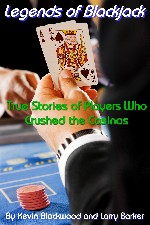
Click here to buy Legends of Blackjack now...
|
Join the conversation.
Comment with your Facebook account — no registration needed.